I suppose I’ve been a systems type thinker all my life and so it is strange to me how rarely most people connect dots. To me it is quite clear that the GP was referencing the externalities of fossil fuel based energy (the movie itself was a very thinly-veiled analogy for the same). Given that lack of systemic thinking as a species, it had become quite clear that we will indeed burn up all our resources to build as many paperclips or some other widget as possible. Look up “paper clip maximizer” for that reference if you’d like.
Not sure where you saw an opening to insert religion into the discussion, but there are those out there who aren't happy to sit back in ignorant bliss and pretend some spiritual entity will just swoop in to clean up the mess we've made.
I for one am happy there are more people interested in finding solutions to problems than there are lazy thinkers who will resign themselves to believing problems just fix themselves without input.
How is this different than many other "western democracies"?
For one specific example - The Netherlands with its various tax breaks/benefits - such as buying hybrid or fully electric car, installing solar panels, turning off natural gas (widely used for heating houses/apartments and domestic water) and switch to air based heat pumps and induction cooktop ...
All combined brought the country to a point where it's struggling with electrical grid capacity and availability.
While existing homes tend to have reliable supply of electricity. New homes and companies wait for electrical connection or they still go through with using natural gas despite hybrid heat pumps already being placed, during peak sun electrical grid operators turn off receiving electricity from private solar panels ...etc
The Netherlands is struggling with a lack of grid capacity due to political decisions to ignore the power network management companies that pleaded for at least a decade for expansion.
It is changing now though. TenneT now has some huge projects coordinated with the Ministry for Economic Affairs. All the doom and gloom is unhelpful, the Netherlands has come a long way in the last 10 years and we should celebrate the victories. People only want to see the bad news about a supermarket that couldn’t get a grid connection and declare that it’s all a mess.
There are definitely many places on the grid with big backlogs but the rate of upgrades to accommodate them has accelerated immensely.
Hybrid cars is a good bet... They almost always use less fuel than the same model ICE, have a better emissions profile, and if they're plugin offer a lot of flexibility.
Adding solar panels when peak production is already too much can still make some sense, depending on circumstance. If it reduces long distance transmission by balancing use closer to generation, that's valuable. If it increases the length of time in a day where solar is dominant, that's valuable. If there's enough capacity that it makes sense to build export facilities, that's valuable, because it also brings import facilities and greater stability. If there's enough excess capacity to inspire storage facilities, that's good too.
Otoh, it could just be that the solar subsidies need to be turned off as they've done their job.
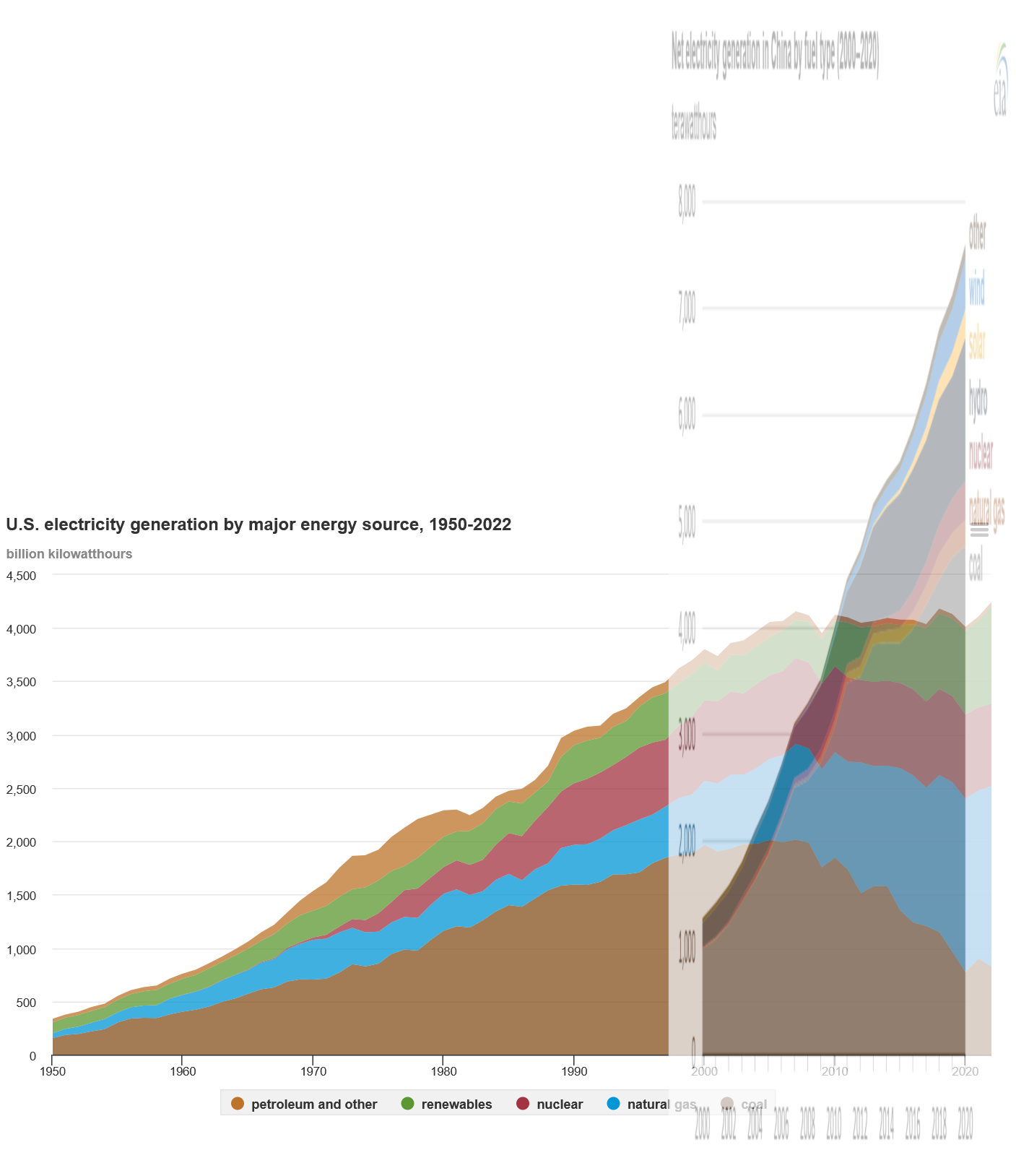
China electricity production from 2000-2020 overlaid on US electricity production from 1950-2023. Seems like it is definitely possible to achieve a steeper slope.
That's beside the point and misses it entirely. Solar and wind are the cheapest thing to build right now, so it's not going to be coal going forward. We have an absolutely enormous interconnection queue because it's impossible to build infrastructure. We'd be much further along with the energy transition if we could stop tripping over ourselves and get on with erecting pylons and wires.
The article is about the US, so I'm limiting my scope to that market. I would need to do more research to competently talk about the rest of the world.
There is definitely inertia in construction; it takes many years to design, permit, build, interconnect anything. Stuff coming online now was conceived years ago, often more than a decade. So if you want to see what the economics favors going forward, you look to the interconnection queue rather than what's booting up.
Right now in the US, the interconnection queue is completely dominated by wind, solar, and batteries. Gas is significant, but tailing off. Everything else is ~noise:
https://emp.lbl.gov/queues
As we can see from the interconnection queue, gas-powered generation will continue to go up. It just isn't going to go up as fast as it has in the past, and that growth is thoroughly overshadowed by growth from solar and wind. If we want the transition to happen faster, we should execute on the existing queue with urgency.
Regarding the rest of the world, again, I'm not sufficiently well-educated to have a useful conversation. This article is about providing for US demand, not rest-of-the-world cleanliness. You do appear to be correct, however, that there's significant new coal going up at least in some places. India, for example, is building a lot of it and I'm not entirely sure why. China, by contrast, is building more than twice as much wind and solar as it is coal and is also taking oil and gas plants offline. https://ourworldindata.org/energy/country/china#how-much-is-...
Yes, China installed more solar last year than the US did in its entire history.
But I need to stop you because we are trying to get to Net Zero by 2050/2060 so we need to stop with the happy feel good shit because it isn’t sufficient
Show us a chart for absolute coal power compared to renewables
Having run the numbers myself, at current trends I'd say there's a 50-50 chance we'll reach electrical net-zero by 2032, and add heating and transport to the net-zero bucket by 2038 (and one of the things which may prevent the former by 2032 is the increasing electrification of the latter; I am much more confident that we will reach ~2 TW-years/year of renewable production by 2032 than I am that this will balance electrical demand in 2032).
The rest of the emissions are things like "Can we stop cow methane? And get a replacement for cement that don't inherently emit CO2 as part of the chemistry of the stuff itself?", which I have no frame of reference for with regard to the difficulty, and may or may not happen concurrently.
It’s not happy feel good shit – China is installing as many renewables as they possibly can, while building more nuclear than anyone else, and it’s still not enough electricity for their growing economy. It illustrates the constraints because they built all of those panels themselves, and they’re the best at making them.
A lot of the coal capacity they are building, though, will be used for peaking, just like a lot of our natural gas plants.
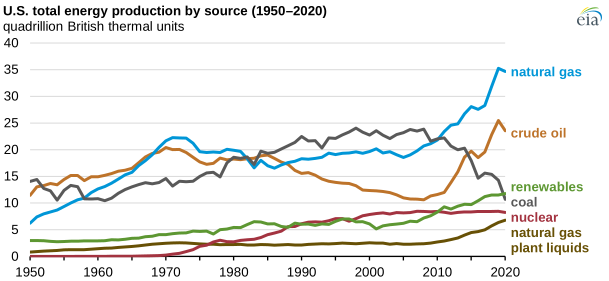
New US energy production since 2000s heavily leans fossil/shale (crude + lng), both ~doubled in past 20 years. Issue is, much of new extracted fossil energy is being exported. US generating more dirty energy than ever, it's just being consumed abroad, not in US.
Recent studies on LNG infra leaks show it's potentially no better to much worse than coal in terms of emissions. Meanwhile at least PRC is replacing old dirty coal plants with cleaner coal plants. And they stopped exporting coal overcapacity - stopped building coal plants abroad, vs US propping up global crude/lng use. And will continue to until shale fields run dry. TLDR is US produces a lot excess dirty energy already, it simply prioritizing exporting that dirty energy due to geopolitics than consuming it domestically.
Yes. But that sort of growth wasn't politically feasible in the US. The most economic options at the time were coal and nuclear, both of which were strictly off the table.
That's sort of my unsaid point - we've made it politically infeasible to build much of anything in the United States. You can see it in everything from a local planning meeting when someone tries to build a fence or house all the way up to transmission lines and power plants. The process itself kills a huge amount of progress by making it a bad use of lifespan to pursue it.
I’m not against coal or nuclear, However, if progress, as it is defined here, includes disregarding the opinion of the minority or does not respect the rules then maybe it is not real progress. Progress must include taking into account the constraints of the rules we have set in place.
We are basically making progress, albeit slowly, in trying to solve the issue in a way that is consistent with law and precedent. This includes a lot of debate and rejection, but over a long enough period of time it can be solved.
To fight climate change, the US needs renewable energy, and fast. Ironically, we already have it, the US has 947 GW of renewable generation capacity that is not hooked up to the grid [1]. To put that number into perspective, the US currently has 1.16 TW of generation capacity in total [2]. We could nearly double our generation capacity today if we could just hook it up.
Unfortunately it takes 10 years to build new transmission lines in the US [3]. Changes are going to need to be made to the process, which may include giving more responsibility and agency to FERC to oversee the review process.
Not all of that capacity in the interconnection queues are ready to flip the switch though, correct? Requests can be pre-construction, construction, built/non-operating, and operating [1]
It’s more that growth just isn’t needed in the US. Nobody is plugging in an EV and not getting power and our population is only growing at ~0.5% per year.
Even with EV’s US electric demand is flat since 2010 while China’s grew 8% in 2023! When things are changing 10+x as fast you need to move faster.
A little, but I’m not going to heat my house to 90f in the winter or install floodlights simply because electricity is cheaper.
States have wildly different prices without changing climate and urban normalized consumption that much. https://www.electricchoice.com/electricity-prices-by-state/ Oregon and Washington have nearly identical per capita electricity usage despite a 10% cost difference etc.
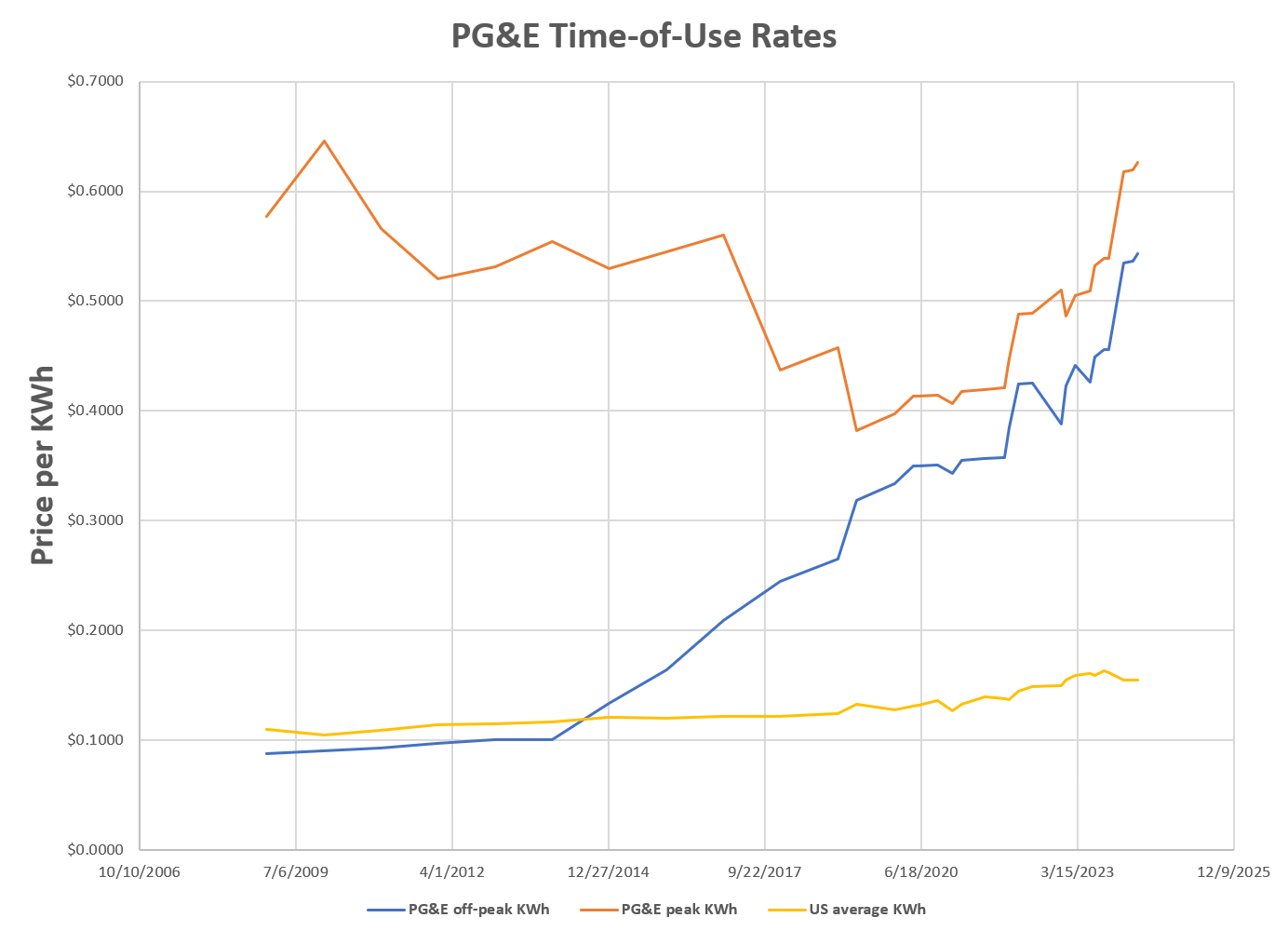
In much of California, electricity prices are high enough that you shouldn't get an EV and you shouldn't electrify your space or water heating because gasoline and natural gas are cheaper per delivered utility.
When my marginal cost of electricity dropped to zero at my single-family home thanks to solar+battery, I dramatically increased my consumption. I got an electric car, two electric laundry units, an induction cooktop, an electric oven, a heat pump pool heater, and am about to switch over to electric space and water heating. I'm using about 4x more electric energy than I did prior to having solar panels, and it's definitely going to keep going up.
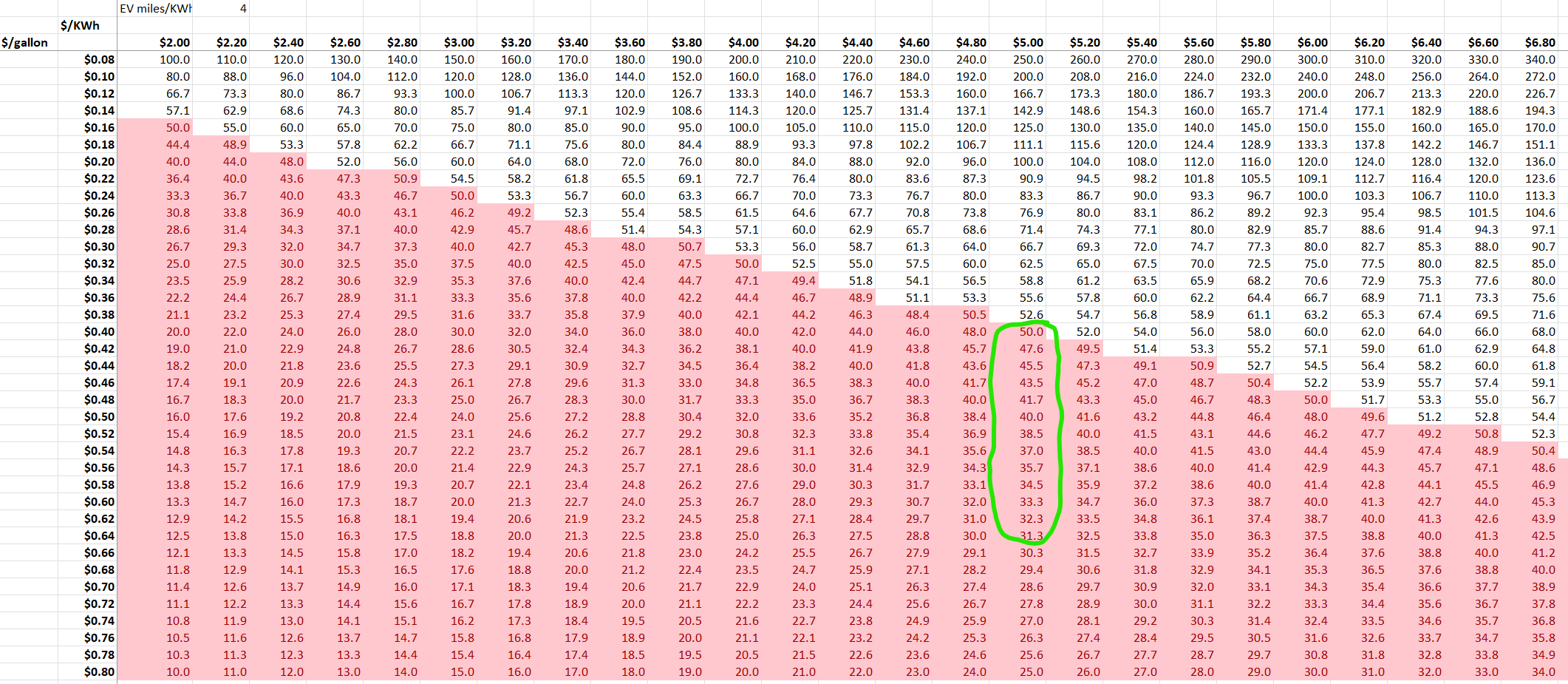
And in case anybody doesn't believe me, check out a Bolt vs an ICE vehicle at current electricity and gasoline costs (about $5/gallon in my area):
https://zlnp.net/serve/bolt-vs-ice.png
Any ICE that gets about 35 MPG or better will beat a grid-powered Bolt. So if you don't self-generate in northern CA, get yourself something like a Prius.
Sure, But there's still decreasing utility to you for each additional kilowatt hour of power you consume. At some point, you are maintaining maximum comfort and convenience in the house, have switched everything over to the cheapest energy source, your driving cost is entirely determined by the price of tires. I guess you could operate an aluminum smelter at home... :)
Using a cs metaphor, it's amdahl's law applied to one part of an overall cost and happiness equation. After a while, the other factors dominate and there's no point in using more energy.
That's certainly true, but the grandparent was suggesting that there was little demand elasticity. My personal micro-economic experience leads me to think otherwise.
Nah, definitely is in places that are using nat gas for heating in particular. But I'm sympathetic to the ggp because the trope of "people will just use more" is a little over-broadly applied as an excuse not to improve efficiency. Like, reducing the energy use of your dishwasher doesn't cause much of an uptick in total dish washing.
And we're all commenting on an article about how growth is picking up again and we're finding it difficult to rise to the challenge. We've only recently found non-industrial (thus easier to permit and therefore possible to grow in the US) productive uses of electricity like data centers, cars, space heating, etc etc.
There is also hydroelectric, which the US can't grow in anymore because it already tapped all the river locations it could use when the US was industrializing, but China can because it is only fairly recently China had industrialized enough to start tapping its own rivers. Of course, once all the river sites in China are exploited, China's growth in that sector is completely done, so it's almost like a temporary boost more so than a long-term growth factor, for lack of better words.
I always think of it like this - what job would you rather have your kid get into, working in construction, or as a lawyer arguing for or against that construction? One job is both a lot cushier and happens to pay multiples better.
Fascinating. I often look at our society and wonder why we set it up so that most people are wasting their lives doing unnecessary "bullshit jobs" (sensu Graeber) instead of setting it up so that people can spend their time on meaningful non-work. Your comment gives me a new hypothesis: because people think like that.
To be clear, this is not exactly what I think (my thoughts tend to be a bit less mainstream I believe), but it is what seems apparent to me. I’ve not met a lot of people who dream of their children doing menial labor.
Supply and demand should correct the situation if we get over-lawyered. Looking at university enrollment rates, it seems that’s exactly what’s happening.
Supply and demand is a concept for when there are buyers and sellers. There is no short term feedback loop for a legal system that gets too bureaucratic/corrupt. That ends up only being visible on a years and decades long scale when the whole country becomes less productive and less trustworthy on the global scale and is outcompeted by other nations with less bureaucracy/corruption.
For example, one might say excess lawyers (either as lawyers or political figures or judges) contribute to excessive liability, which then results in everyone spending extra to cover their ass or simply not taking risks, the consequences of which are only visible in the long term. But supply and demand won’t fix this issue in a sufficiently timely manner.
The Bloomberg Oddlots podcast had an episode a few weeks ago about a boom in starts for natural gas power plants; if I remember correctly, they were saying that the infrastructure people who normally run the grid are used to thinking in decades but are now thinking in years. So it seems we will be working hard to increase carbon emissions at a time when we should be cutting them drastically. It does not bode well.
This is what people said about nuclear power as it stopped being an exponential rise in the mid-1970s. As a power source becomes built it more places, its externalities generally get more regulated. Happened with coal (acid rain, air pollution) and nuclear (Browns ferry fire, TMI, Salem atws), happening now with wind and solar (land use, intermittency)
The grid in Western Massachusetts is over burdened. Local colleges are building their own peaker co-gen plants to meet needs.
From my POV the US grid needs a rethink that prioritizes local production with large transmission lines used only for redundancy access.
We should probably break down our energy usage between heating and everything else. The heating load is my biggest obstacle to net-zero. I'm working on solar thermal designs to get to zero. Solar thermal avoids the need to interconnect with the grid which currently is maxed out.
It's basically same everywhere in the world - except some places don't mind nuclear, coal, or natural gas.
Few places have enough elevation and water for hydro (and don't mind submerging loads of land to make it happen).
For almost all countries - experts (engineers and scientists) have been warning grid and production will not be enough, and politicians kept focusing on shorter term wins of votes.
The economics are still a little shaky for home solar installations, particularly when you factor in batteries. Larger "water batteries" instead of hot water heaters would make a dent but we need more passive storage.
I started looking at the cost of solar installations vs. future energy costs and this has worked out well.
The long view is critical so I looked at the solar install costs against the retirement cash flow needed to pay for energy.
My first install has got to be over 10 years old by now and has been completely trouble free. I have sold SRECs in that time that have almost paid for the system. I only receive an electric bill in the winter(heat pumps). I also received text incentives at the time. I feel like now I'm in a position where my only costs will be replacing failed components. These components replacement costs will be a fraction of the original install and will perform better.
I recently moved from a house without solar to one with a small ~7kW rooftop installation. Most important variables are similar: House size, electric usage patterns, location, and so on. I'm seeing a very small cost savings compared to my old house, maybe 10-15% at most. And I went from a consistently high monthly bill to a variable (but never zero) one, with an annoyingly giant "true up" cost mid-year. Given the economics, I would have never have chosen to install it if I didn't already have it. It would take decades for the investment to pay back.
The installation is unfortunately also grid-dependent, so it's useless when the power goes out.
It's highly dependant on location. Labor costs, tariffs, net metering arrangements, solar irradiance, solar seasonality and local cost of electricity vary a lot.
The energy can be used more directly. The real bonus of solar thermal for me is that there is no regulation compared to solar pv which is grid tied and regulated for me.
Why did this get flagged, exactly? WSJ is "reputable". There's no comment with an archive link to bypass the paywall (yet) but paywalled articles don't automatically get flagged AFAIK. The comments here don't give any hints thus far. I can only conclude it got flagged because it's so blatantly crushing the techno-optimist dreams of the median person here?
Edit: Touched a few nerves it seems. Go touch grass kiddos.
There are people who knee-jerk flag everything from WSJ. Usually because, in their words, "it's a Murdoch rag". They'd rather get their news from random blogs, splogs, and tweets I guess.
No, I flagged it because it's paywalled and there is no workaround as near as I could find. So all most can do is discuss the title, which is not useful.