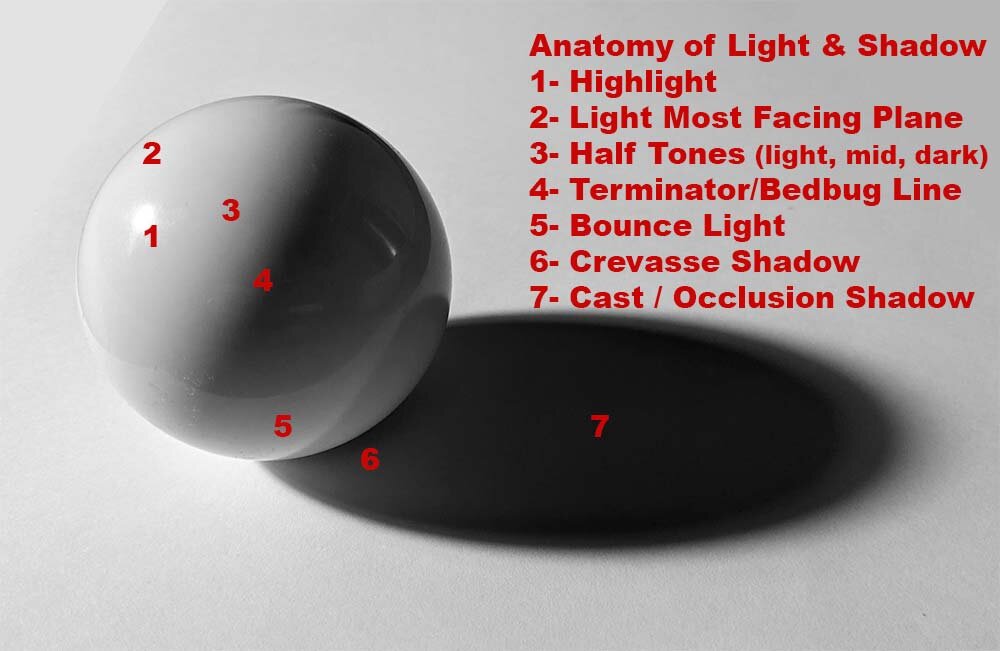
Getting shadows right is incredibly complicated. You need to figure out the silhouette of the object from the perspective of the light source, then project that silhouette over the geometry the shadow falls on, then draw the perspective of that projection from the point of view of the “camera”. So it is a perspective of a projection of a perspective. And to add to that, objects occlude each other, and you might have multiple light sources. Since most artists probably start with a composition in the 2d space of the artwork, there’s never really a coherent 3d space to place the light sources in or figure out those projections in. I don’t think you should expect anyone to get it right in a complex scene unless they are drawing from reference.
> Since most artists probably start with a composition in the 2d space of the artwork, there’s never really a coherent 3d space to place the light sources in or figure out those projections in.
Highly skilled artists don't just think in 2D — they really do imagine the 3D scene that they're painting. It's hard to relate to but people with a lot of drawing/painting experience can "feel the form", as they say, when they draw. But it's true that figuring out the lighting is still difficult even then.
I do want to point out that if you look at talented painters from later in history than the early renaissance, they don't make nearly as many mistakes as the ones in the article, although of course the lighting of imaginary scenes is still always approximated and simplified.
It's a skillset that gives you a very different way of perceiving the world. I find it difficult to describe but "feeling the form" feels close to my experience while drawing. When I haven't drawn in a while and I pick up a pencil my first few sketches are always stiff, awkward, and cartoonish. It's like I'm drawing an emoji or a logo or something. Then after a little while I remember how to feel the form again and I start to be able to articulate the shape and the weight of an object and translate that convincingly to the page. It really isn't thinking in 2D, per se, it's thinking in...flattened 3D maybe?
To your point about painters from later in history, I think once linear perspective was codified and became more widespread it made the process of projecting shadows much easier for artists. In a lot of renaissance artwork you can actually map out the perspective lines to find that the artist was working with multiple incompatible vanishing points, hence the wonky spatiality of many of the paintings from that era.
Took art class in college a few years ago for kicks. One of first things is learning to see lights and darks. Spend 3 hours a day for several weeks in a pitch black room with only a single source light. Eventually working to drawing a curtain in charcoal. You don’t try and draw a curtain.
No form to it. You just have to draw lights and shadows as you “see” them. At end you have a well drawn curtain.
After awhile your entire perspective even outside of class changes. You naturally see lights and darks. Not just objects.
You can get a taste of this at home, for anyone else wanting to experience a new perspective. Find a nice photo of a person, probably a 3/4 body shot (album covers are great too), black and white helps but color is just fine too. Flip the image upside down. Now sketch what you see without flipping the image or moving your head around, focus on what you see in front of you as it exists. Don't rationalize it or think about the grand act of drawing a person. You are just sketching the dark circle, or a curved line.
It's a common technique when learning how to recognize lines, shapes, and shadows. The simple act of flipping an image upside down is enough for your brain to turn off it's automatic recognition magic that keeps you from seeing primary forms.
Do it enough times, and like other visual artists, you start admiring a lot of things people take for granted about vision.
I took an art elective in college. One of the exercises they had us do was to find a black and white face in a magazine, cut it in half down the center of the face, tape it to a piece of paper and mirror the face on the paper. To get full credit, when the paper was hung up on the wall across the room, the professor could not tell which side was the magazine picture and which side was your drawing.
That's right. I remember being told to flip a painting I was working on upside down. Walk 30 feet away...
It was a great trick that took me out of the painting that I had been doing from my "mind's eye". I saw it for the light and dark areas that is was. It allowed me to see how I could rebalance it (regarding the lights and shadows). Very cool.
Yes exactly! You give yourself a new perspective to solve the problem.
If you have ever seen a professional digital artist draw, you'll notice them flip the canvas repeatedly. You might think they're crazy how much they flip it, but this really does help turn off that part of the brain that got too used to the drawing. Too used to the auto correction magic our brains love performing.
This technique forces them to see that the curve they just drew feels off, even when their brain with the image right side up refused to see it.
I can totally see why digital artists would get value from this!
I work in VFX and have found that after watching a shot on loop a few hundred times (over weeks) it can be quite helpful to watch it 'flopped' (horizontal mirror), which seems to be able to give nearly a whole-new perspective (on the effects-content) in many cases.
Sometimes you can get too carried away with drawing exactly what you see. Once I drew a person based on a photo I had on my desk, only to realize that since I was looking down at an angle to it, the drawing was all distorted. :)
An art teacher told me what is kind of obvious: things aren't outlined in the real world. Painting a still life — the apple is in fact simply defined by where the apple color ends and the bowl color begins.
To be sure, when we start sketching we would probably find it convenient to make a little arc on the page that delineates the boundary of the apple but by the time you move to finishing the piece (if realism is what your going for) a line of any thickness delineating the apple should be gone.
Your art teacher was correct. The problem is that humans start off with a linear approach to drawing. The first drawings they do as children are done with lines, and tones are usually an afterthought.
Although unnatural outlines seem to be popular in photos - the usual sharpening algorithms don't make boundaries around objects clearer, they just add white halos.
I always found this very objectionable but noone ever seems to implement warp-sharpen when they can do unsharp mask.
yup! people draw with "Shortcuts" instead of putting the actual value of things on the page... my favorite exercise was dividing a canvas into a 1" grid and taking a 1 inch brush and filling in each square by mixing the correct color one at a time like a raster, you end up with a really true to life pixelated painting.
You have stated the problem exactly. However, in practice a painter employs a fair amount of 'bodging' (favoring appearance over exactitude). For example, it is not entirely unusual to discover that a landscape features more than one implied sun. In 3D rendering this would be done with light-linking, whereby different objects are exclusively light by different lights. Physically impossible, but visually convincing.
In the time I worked on computer graphics (late 90s to early 2000s) I had lots of fun learnign to render basic lighting effects in OpenGL using shadow mapping which includes a clever application of the depth buffer. It was also enough to convince me that techniques short of ray casting would always be ugly hacks.
I am actually really impressed with the current state of the art for real time rasterization: cascaded shadow maps + global illumination or even just screen space ambient occlusion. I feel it comes close enough in most scenes. At least when the purpose is to look pretty and not stand out as obviously wrong while playing a game. The cases where it fails are mainly the pathological ones such as caustics.
That said, it is still amazing how big the actual gap is between this and ray tracing when carefully analysing a complex scene.
Eggs make excellent light studies. No shape complexity, texture complexity can be ignored, and depending on the surface they are placed on the colour complexity can be adjusted.