Dürer's Rhinoceros is a case of an early second-hand interpretation of a novel and (at least to European eyes) rare experience. Aside from its remarkable artistry and impact, I also found it significant as an exemplar of how understanding looks when information is remote, rare, or uncertain, but improves over time.
Dürer got many specifics wrong, but the Gestalt of his rhinoceros is true to the original --- an original he'd never seen. And that that original was real, unlike other fantastical creatures (dragons, griffins, unicorns, kraken) which were often reported or pictured, but for which we've found no evidence. Over time, evidence of, and information on, the rhinocerous became more substantial and converged on a more consistent and accurate understanding.
Which gives a notion for determining when some novel, rare, and uncertain phenomenon does reflect on some ground truth of the Universe, and not merely hallucinations at the edge of perceptibility. I'd chosen Dürer's image to illustrate that concept:
>It has been said of Dürer's woodcut: "probably no animal picture has exerted such a profound influence on the arts".[7]
I'm reminded of the first identified Neanderthal being arthritic, resulting in their being constantly depicted as stooped and bent even in the modern era.
Or early (mistaken) estimates of the mass of the electron, which were presumed correct by later experimenters who would shade their own findings down to match. Richard Feynman discusses this.
Feynman was remarkable for many reasons, but one that particularly stands out for me is his skepticism toward science and scientists. The essay Cargo Cult Science is a great example. His kind of intellectual rigor is sadly rare among public intellectuals today.
I use this picture when I'm telling my kids how important a coherent point of view is in writing. This woodcut has almost no detail correct, but it's a convincing picture of a rhinoceros nonetheless. Dürer had a clear mental image of the whole beast, and communicates that critical point through the noise of all his misunderstandings.


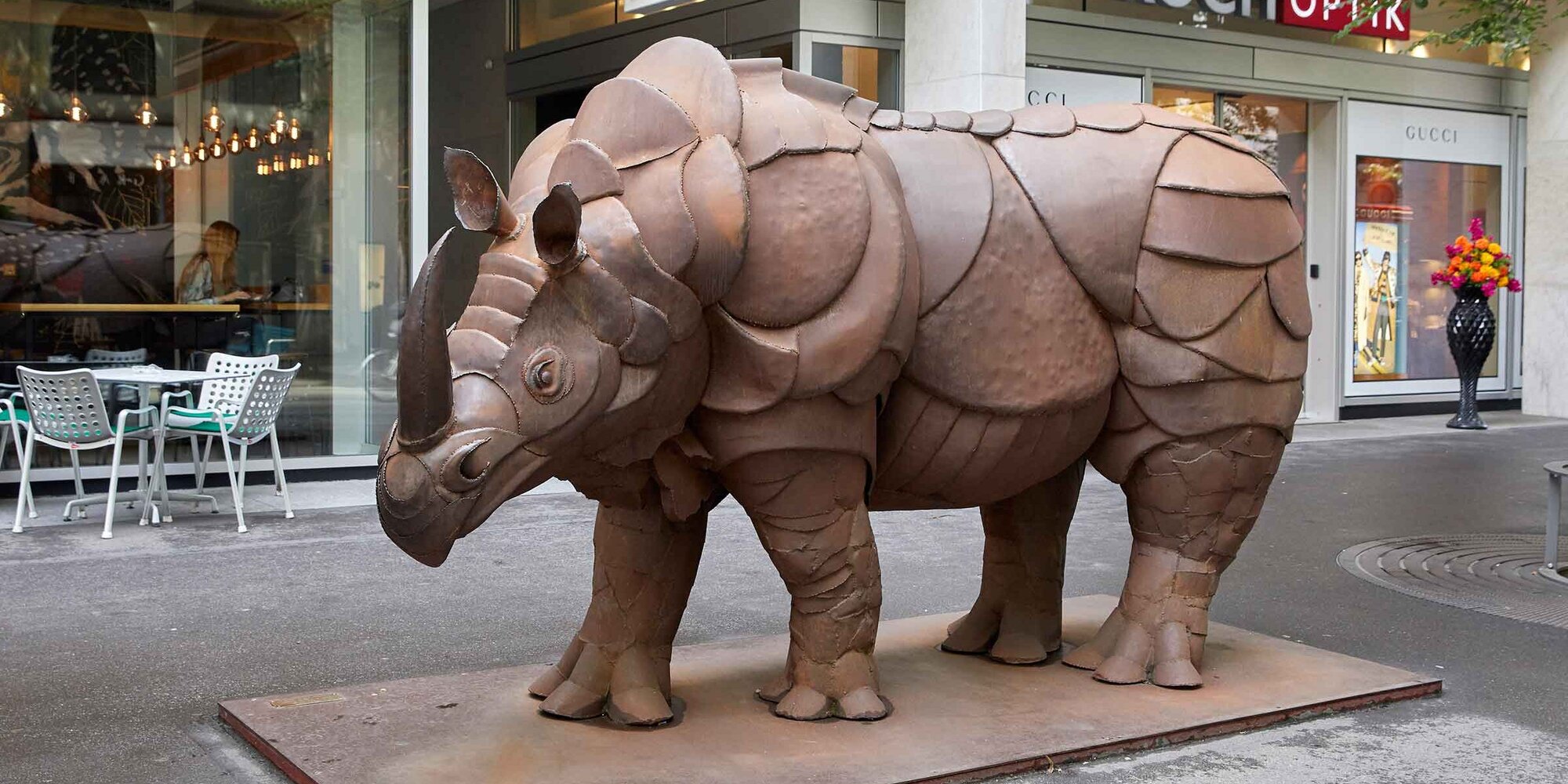
Dürer got many specifics wrong, but the Gestalt of his rhinoceros is true to the original --- an original he'd never seen. And that that original was real, unlike other fantastical creatures (dragons, griffins, unicorns, kraken) which were often reported or pictured, but for which we've found no evidence. Over time, evidence of, and information on, the rhinocerous became more substantial and converged on a more consistent and accurate understanding.
Which gives a notion for determining when some novel, rare, and uncertain phenomenon does reflect on some ground truth of the Universe, and not merely hallucinations at the edge of perceptibility. I'd chosen Dürer's image to illustrate that concept:
https://joindiaspora.com/posts/874e7c10d09c0139a7e5002590d8e...