It wont help that North Carolina Senate in 2012 voted to prohibit agencies and towns from using the latest scientific data on sea-level rise in coastal management decisions.
In the mean time it only adds additional ammo to the Cities versus States "Civil Cold War" going on right now. Cities like Miami absolutely know and are tracking climate change, because they have to, and the complaints of City Mayors to State Legislatures with Blinders On show how painfully divorced most US States currently are from their tax bases, having willfully gerrymandered themselves to give a disproportionate vote to rural concerns over urban concerns.
It's not because they wanted to give rural votes more weight.
The Republican Party ran a massive, coordinated operation to take over state legislatures, who control the redistricting process, to ensure GOP dominance in the House.
In 2012, more votes total were cast for Democrats, but the Republicans retained 33-seat majority. The state laws ignoring climate change in favor of fossil fuel business is just a side-benefit.
Oh yes, they knew what they were doing. Rural votes typically vote more conservatively and urban votes typically more progressively/liberally. Giving rural votes more weight was definitely the strategy to get more weight to conservative votes. The cities versus rural counties "Cold Civil War" is absolutely the intentional consequence of the Republican strategy over the last many decades. The next question is how long this particular civil war stays cold, given how much increasing ammo (lit. and fig.) is being stockpiled by each side.
Honestly, everybody knows what the game is. The left should get their shit together and play the game that counts (winning elections), rather than the one that doesn't (% of popular vote).
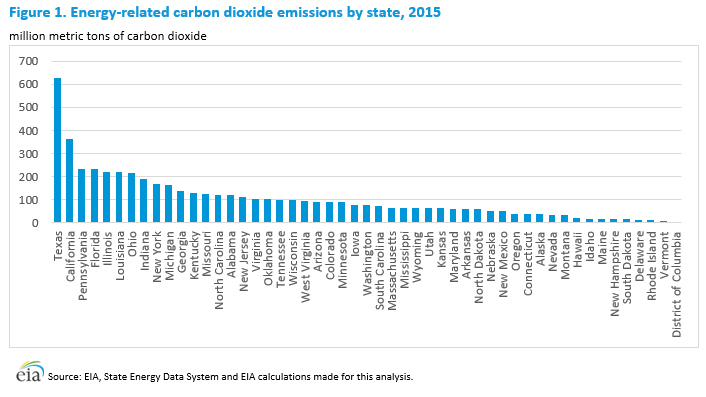
California hardly has a Republican party at all anymore but produces more greenhouse gas than any other state.
And before you try to rationalize this with "per capita" arguments....you don't lose your home or get cancer "per capita"...the absolute numbers matter and California has higher absolute numbers than any other state.
And before you try to rationalize this with "per capita" arguments
This is moronic. After all, the other 49 states combined produce more greenhouse gas than California. Don't try to rationalize that with "per capita" or "per land area" arguments, the absolute numbers matter.
your points are true at an individual level but CA is the 3rd largest state and has, by far, the largest population. It is roughly the same size and population as all of Spain, for example.
So since the USA has the largest global economy it should also get a pass? Good thing then we didn't sign the Paris Accord, being the largest economy and all.
The Chinese will also be happy to find out that by virtue of having the largest population, they also get a ready-made excuse.
You seem to be acting like California is not taking the most active steps among all the states for curbing emissions. I have absolutely no idea what point you're trying to make.
It will as a cautionary tale if nothing else. If NC's groundwater is polluted from coal ash and their tourist industry devastated from their head-in-the-ground attitude while South Carolina thrives it'll eventually force change, despite (IMHO) lobbying by energy industry interests.
The IPCC high estimate of sea level rise by 2100 is about 0.6m over 80 years. It's not good, but it's hardly a catastrophe. I take predictions like this about as seriously as the narrative that global warming is a hoax.
I’m not sure you actually understand what a 2ft rise means. Ignore all feedback mechanism (various other commenters have said things about the conservatism of ipcc) let’s look at it basically:
1. Go to a beach at high tide. Look at where the water is and add two feet. For sandy beaches that probably gets you through the dunes.
2. Look at the beaches at low tide. How much further out is it? Measure the distance between low and high tide points and see how far inland you get to see where the ocean gets to.
3. Go to marshlands - add 2ft to low tide and see if they’re still marshlands or if they converted to shallow ocean. Similarly check high tide, what surrounding land would be submerged if you added 2 feet of water.
4. Consider places near the coast that are lower than the high point of the beach. Now “spring tides” could get over that point and essentially turn that land into a swamp.
Finally of course, consider what happens if/when the ocean reaches farm land. The reason “salting the earth” is a phrase is because high salt content (as you might get from even short term flooding) kills most plants unless they’ve specifically evolved for high salt concentrations. Most grains for instance have not.
This of course ignores special cases like the Netherlands, Venice, etc that are already having to engineer solutions to a few inches of sea level increases.
I understand what sea level rise means. Pieces of cities and maybe a few whole cities will need to be torn down and rebuilt elsewhere. Building cities on a century timescale is not difficult. (How many of the vulnerable houses are more than 80 years old now?) Building new farms is trivial.
A 2ft rise is catastrophic if it happens in a day but not if it happens over 80 years. The IPCC report shows about a 1ft rise from 1900-2000 which no one seemed to notice (other than the engineers whose job it is to deal with). I would expect a 2ft rise this century to be about twice as bad, so not that bad. The Netherlands is proof that this type of thing can be handled with time and engineering.
1. There will be new dunes, again above where the water reaches.
2. The beach will be the same size.
3. There will be marshlands. They will be in new locations. We might even get more.
4. Yep, lose some swamp and gain other swamp.
It all moves.
We can get more than a 2ft rise just from drawing out groundwater, causing the land to sink. We can get way more with an earthquake, going either direction. The land goes up (and the water relatively goes down) if the weight of a glacier is removed.
I live in Florida. Sixty cm would be a catastrophe here. A multi-trillion dollar one. Storm surges flood the streets every rainy season now. Raising that by a couple feet would require what we currently think of as impossible measures to fix.
IPCC estimates are always highly conservative and often do not account for positive feedback mechanisms. I believe the most recent report accounted for 0 feedback. The sea level is not constant around the world. An average increase of .6m would likely be about 1m in the Northeast including Boston, NYC, and DC and only about .3m on the pacific coast.
Edit: And the .6m (if that is correct) is just the baseline. Even if that is the level 364 days a year, one storm surge on one day with all that additional volume can put the entire city out of business.
> It is virtually certain that global mean sea level rise will continue for many centuries beyond 2100, with the amount of rise dependent on future emission.
There is a German saying for your kind of approach: "Nach mir die Sintflut", means "After me the deluge".
.6 m is quite devastating, but less so for US housing than for food security. Some of the world's producers of food are almost at sea level. If you'd like a hard nosed data and finance driven look at what global warming means, I'd recommend taking a look at this
"the cost of doing this for all at-risk Americans would be eye-watering. Estimates range from $200,000 to $1m per person to undertake a relocation. If 13 million people do have to move, it seems fantastical to imagine $13tn, or even a significant fraction of this amount, being spent by governments to ease the way.
“As a country we aren’t set up to deal with slow-moving disasters like this, so people around the country are on their own,” said Joel Clement, a former Department of the Interior official who worked on the relocation of Alaskan towns."
This seems like an extremely expensive move. Reading TFA, it isn't clear whether these are the costs of moves or of home buyouts. If these estimates are for buyouts, they should be multiplying by the number of households, not the number of people. Also many of these properties are vacation homes or rentals. It's fine to help people whose primary residences are threatened, but we shouldn't subsidize poor investments.
Sometimes I wonder what in the world people are thinking. Does anybody actually find this a remotely reasonable estimate? Or even anything completely short of absolutely ridiculous? I moved, along with my wife, literally half way around the world for less than $5k. For $200k, you could spend a like 2% of that on moving costs and then practically retire in many parts of the world.
In the US the median personal income is around $35k. So you spend let's say $2000 moving and then you have $198k, or more than what most people will earn over the next 5 years for what?
Things get pretty weird when you start contemplating doing things at this scale. My father likes to tell of how, supposedly, McDonalds was considering introducing a new menu item, let's say it was an eggplant burger (I forget). The first question they had to answer was does the entire world produce enough eggplant?
Also, critically, if due to catastrophe you abandon your $100k home and buy another $100k home in another place, your move cost $200k.
Your McDonalds example is a really good one. McDonalds, as of 2012, serves about 68 million people per day. In climate migrants/day we get an aggregate of 13 million over 82 years. That works out to 434 per day. And that's on the extreme negative end of outcomes for climate change.
To give some context to the numbers here [1] are states' net migration rates. So for instance Florida currently has a huge net migration rate of 16/1k. For a population of 21.3 million that means they're seeing 340,800 new residents per year. That's 933 per day. So the entire climate migration, in the worst case scenario, will involve the entirety of the US taking on half as many residents per year, as Florida alone already does. Of course it won't be entirely evenly spread out, but it also won't be jumping from e.g. 20 people/day to 20,000 people/day. It will mostly pass without major notice and, as the article mentions, is indeed already happening.
This makes for nice shocking headlines, but this entire article is extremely hyperbolic. At the same time I don't think anybody really cares. It seems like people want to be terrified, even when the numbers in no way justify the claims. We are increasingly indeed living in a post-facts world.
> Also, critically, if due to catastrophe you abandon your $100k home and buy another $100k home in another place, your move cost $200k.
I don't think that's right. Let's say I "own" a $100k home, and have a $100k mortgage. I walk away from that house, buy another $100k house with another $100k mortgage. At the start, I have a $100k asset and a $100k liability, for a net of zero. After, I have a $100k asset and two $100k liabilities, so I have lost $100k.
Alternately, let's say I own my $100k house free and clear, and have another $100 in the bank, for total assets of $200k. I abandon my house (writing the value down to $0), and buy another house for $100k. Now I still have the $100k house, but nothing in the bank. My total assets are $100k, so I've lost $100k.
The bank sues you for the 100k unless you live in a non recourse state. In that case, the feds consider that forgiven 100k income and you’ll owe taxes.
> The bank sues you for the 100k unless you live in a non recourse state. In that case, the feds consider that forgiven 100k income and you’ll owe taxes.
My scenario assumed you still owed the $100k. If you live in a non-recourse state and just walk away, you're probably not going to be able to get a new mortgage.
The only reason you can move so cheaply is because someone else is going to move into your living space. Somebody with a mortgage can’t move for $2,000 unless they can find a buyer.
This is a process that will play out over 80 years. It's not like everybody will be trying to sell tomorrow. Values for affected properties will go down slowly over time.
I'm pretty skeptical of that. It seems like individual property values will hold steady, then drop suddenly once an event occurs that convinces people the property is no longer viable.
The part you're missing is that the value of the houses being relocated away from is lost, as they've become uninhabitable due to rising seas.
So it's not the cost of the relocation here that's at issue; that's comparatively cheap. What's very expensive is the loss of all of that property and infrastructure that is left behind and will need to be rebuilt elsewhere.
There is quite a bit of competition in those industries, so changes in cost get passed along quite quickly to consumers. For example, the price of crude oil has varied between $40 and $150 since 2008, but Exxon's profit margin has stayed pretty consistently between 7-10%. When costs go down, Exxon doesn't keep the surplus, it has to pass the savings onto consumers.
The implication of that is that consumers, not the oil and coal companies, were the primary beneficiaries of externalizing the costs of pollution over the past decades, in the form of having access to cheap fuel.
Put another way: Exxon last year had revenues of $240 billion, and profits of about $20 billion. If allowing pollution to be externalized means that gasoline costs half of what it should, that means Exxon's customers saved $240 billion by pollution the environment. That's more than Exxon's profits in an entire decade.
Do you think that, if climate change research hadn't been actively suppressed by the petroleum industry, we would still be on our current usage trajectory, and Exxon still would have made their $20 bn profit this year?
Yes, absolutely. Whatever they attempted to do, the petroleum industry didn't do a good job suppressing research on climate change. The UN Framework Convention on Climate Change was ratified in 1992. Being a child of the 1990s, I grew up learning about anthropogenic climate. Yet, the 1990s were the era of cheap gas and SUVs. Indeed, SUV sales were completely unphased by all the additional information coming out on climate change in the 1990s and 2000s, dipping down temporarily only in response to the Great Recession, then quickly picking back up. People are completely unwilling to alter their lifestyles to reduce CO2 emissions, except in token ways. (Perhaps that's rational, because reducing carbon emissions isn't going to do squat to avert climate change in light of the rapid industrialization of the developing world.)
We can treat the petroleum industry as scapegoats, but at the end of the day we'd be trying to divert responsibility for their selling a product that we desperately wanted.
I don't buy this analysis. Surely you also remember how quickly people ditched their SUV infatuations as gas prices rose after Hurricane Katrina. And you must also remember strongly politicized and partisan climate change discussions were until about a year ago.
That said, my understanding of the fossil fuel industry is that consumer automobiles only make up some small fraction of carbon emissions. I don't have a source (and I would love to see one), but I was under the impression that the majority of carbon in missions were due to commercial shipping and electricity generation. Nobody was out in the streets demanding cheaper electricity and cheaper products on Walmart shelves. Industry simply provided those things. You basically can't blame consumers for shifting consumption towards cheaper goods, that is why externalities are externalities.
Also consider this erratum from my previous post: how much ExxonMobil shareholder equity and executive compensation over the last 20 years can be attributed to lack of political will to action on carbon emissions and climate change? Surely that number is big enough to at least make a dent in the relocation task at hand.
Personal vehicles make up 20% of CO2 emissions--a significant amount. More importantly, peoples' intense opposition to policies that would increase the price of gas are a reasonable indicator of how they'd vote on anything that would force internalization of the costs of CO2 emissions. Right now, even Democrats in California are bailing on a modest 12 cent per gallon hike on gas taxes: http://www.foxnews.com/politics/2018/09/24/california-democr.... How do you think those same voters would react to policies that significantly raised the price of their electricity, their milk and eggs, etc.?
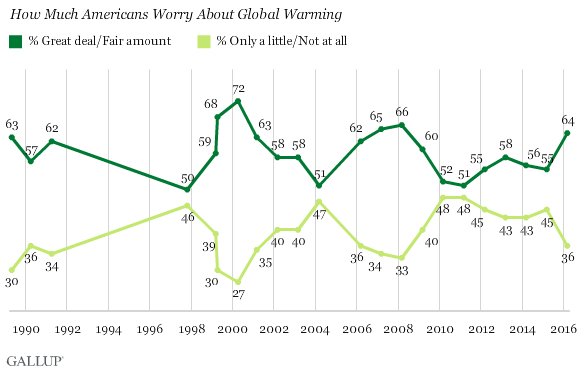
People are unwilling to make lifestyle changes in response to climate change. It's not because they don't know. The majority of people polled stated they were concerned about global warming back in 1990 (about the same as today): https://content.gallup.com/origin/gallupinc/GallupSpaces/Pro.... They're just not willing to do anything about it. Which is why even Democrats won't propose a carbon tax.
This follows the usual trends expected from California ballot propositions. The rule of thumb is that, once campaigning starts, ballot proposition support drops by about 10 points. So a proposition needs about 60% support to survive to election day. Prop 6 never had that support. (It could of course still pass: that rule is only a rule of thumb.)
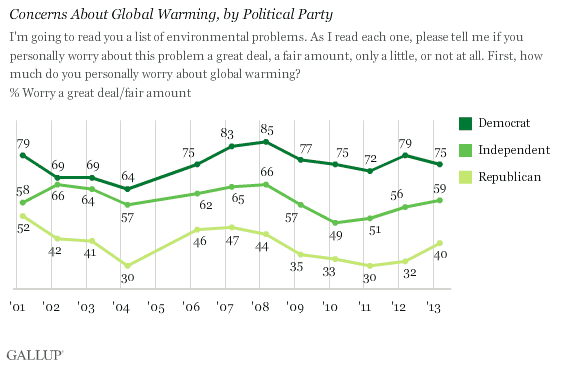
It’s ranged from over 50% in 2000 to a low of about a third during Obama, then back up to 40% now. It seems more connected to political rhetoric than any changes in climate science.
As someone who has spent a decent amount of time living in Atlanta, I’d guess the prices you’ve found reflect that it’s just not that desirable of an area. There are plenty of opportunities and all of the amenities of modern life but Atlanta, and the broader surrounding areas, still have cultural scars from decades of racism.
> Atlanta, and the broader surrounding areas, still have cultural scars from decades of racism
Centuries. By the way, Newnan is named after a slaveholder.
The area is also scarred by decades, close to a century, of car-centered development. It looks like the city that ought be renamed with $100k units is extremely car-dependent.
The parents is talking about the scars of racism; namely from the highway riots and continued white flight (unconscious).
Newnan, Palmetto are about the same distance from the city center and Buckhead as South Forsyth, Canton, yet property sells for 1/3; most likely because south Atlanta is in some ways a desert.
> Prodded to name refuges in the US, researchers will point to Washington and Oregon in the Pacific north-west, where temperatures will remain bearable and disasters unlikely to strike. Areas close to the Great Lakes and in New England are also expected to prove increasingly attractive to those looking to move.
The NorthEast could have earthquake issues in the next 50 years. Parts of New England are much better than other parts. Great Lakes area seems good as do areas like Atlanta, Nashville, Charlotte, Chicago (technically Great Lake area), Denver, and Austin.
Meanwhile, I'm preparing for the M9.0 earthquake that is overdue near the Portland metro area. Portland will burn like a roll of toilet paper when that quake strikes.
I feel bad for those who keep getting flooded. At the same time, we should be asking the question, should we as a society allow structures and private property so close to bodies of water. Flooding is one reason, but the 2nd more important reason, is people should have public access to our lakes, rivers, and oceans. There should be a public buffer of land between the water and private land. Private property should not be flush up against our water boundaries.
The real question we should be asking instead is whether we should be backstopping these private properties with government funded insurance. Remove the backstop of government insurance and the market will quickly solve this problem.
Exactly. Government subsidies [thing]. [thing] becomes more popular, resulting in unforeseen consequences. Government must now do [stuff] to fix what [thing] caused!
Someone I know recently bought a beautiful beach house in Florida near Cape Canaveral. I'm too anxious to ask if she is familiar with the climate change issues in the area since they are almost at sea level and even NASA is struggling with climate change there.
On the other hand, I hope that where ever these American climate refugees go, that the cities they go to will have enough infrastructure especially for water, and if they don't, they can fix it.
Any article which has the word "could" in there gets put into the speculation not factual bin.
So when the article starts with:
"By the end of this century, sea level rises alone could displace 13m people."
we are in the wild speculation category and I know it's not really worth reading. It might be true but so might many other contradictory claims. Non the less, articles like these are not written for information but to cater to a market of people who believe the world is going under tomorrow and love to dwell in it.
Yes, there is a large market for it, unfortunately these are the people who yell about "believing in science". Noble goals, but I'm concerned they're useful idiots in a political game where the real players don't give a crap about the environment.
I don't think the timescales here are realistic. The pace has picked up on global warming and the feedback loops are in place. Projections for '2065' are a bit silly. There is also this small problem in that the 'American empire' is on the decline. Currently the US (and UK) live off the rest of the world via tax havens, the petro-dollar and militarism. These instruments are not going to last forever and it is not possible to plot a linear graph of 'sea level rises' and 'insurance prices'. Everyone in affected areas will be caught out by 'negative equity' with nobody wanting to buy their property.
Sad that you are being downvoted when you are describing the relevant macro trend. Our goal as stewards of civilization has to be to manage through this transition as peacefully as possible.